
Wednesday, 15 April 2026 | 13:00 to 14:00 ET
Register here the Zoom information
Since confederation, prime ministers have created narratives and stories based on a series of unifying national ideas that have been reformulated and expanded over time to keep Canada, a geographically large, ethnically diverse, and regionalized nation, together. This paper shows how prime ministers were identity entrepreneurs: regardless of political stripe, they worked to build national unity, forged a citizenship based on inclusion, and defined a place for Canada in the world. Collectively, they told a national story of Canada as a progressive liberal state with a fundamental belief in universal rights and freedoms. Mark Carney has continued that tradition, resurrecting earlier narratives about Canada’s place in the world, hope for an economic union, and rekindling a sense of identity that has been weakened in the previous decade. The challenge for him is to build a narrative of Canada that moves beyond Canadians’ anger and frustration with Mr. Trump.
This talk will be moderated by Laura Bisaillon, Associate Professor, Sociology, and Health and Society at the University of Toronto.
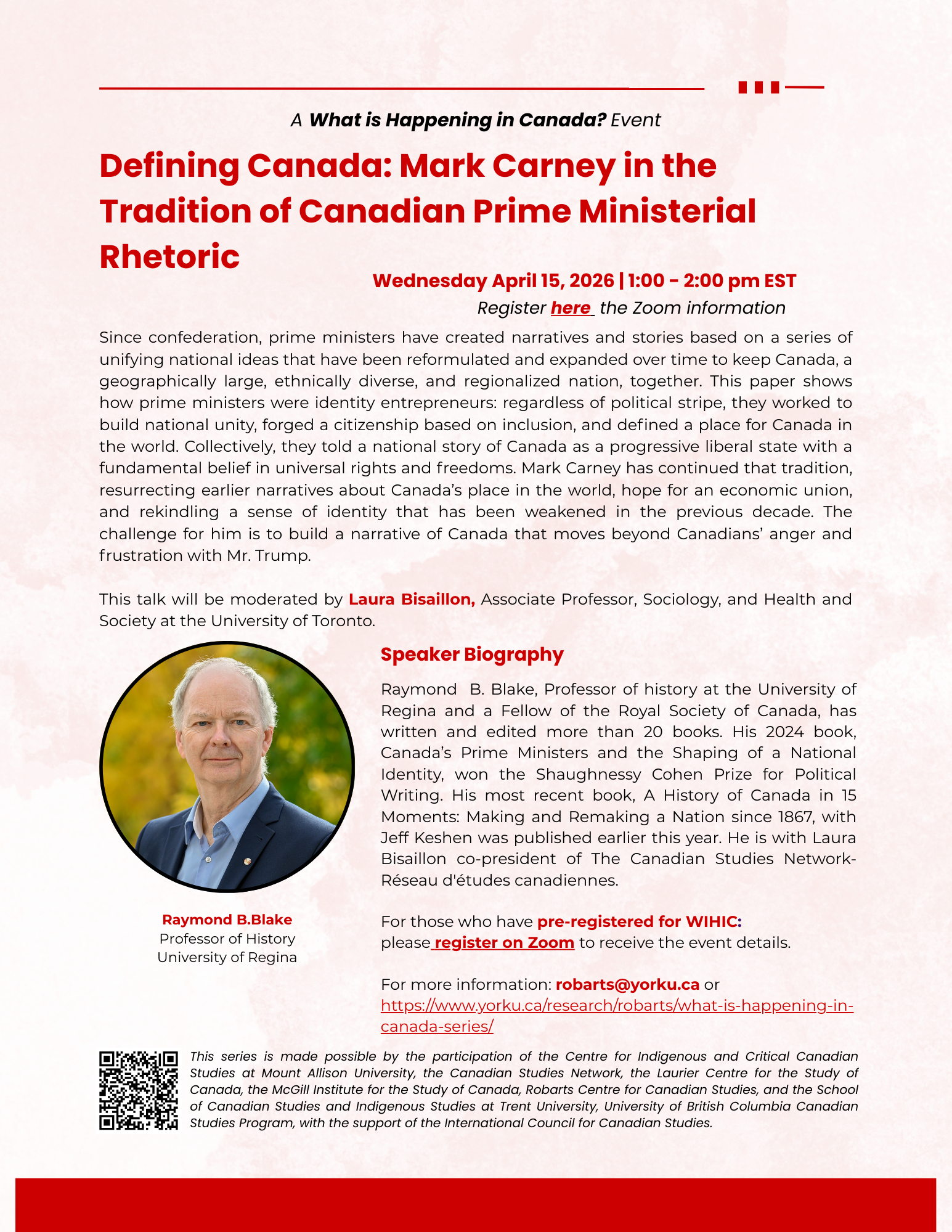
Raymond B. Blake, Professor of History at the University of Regina and a Fellow of the Royal Society of Canada, has written and edited more than 20 books. His 2024 book, Canada’s Prime Ministers and the Shaping of a National Identity, won the Shaughnessy Cohen Prize for Political Writing. His most recent book, A History of Canada in 15 Moments: Making and Remaking a Nation since 1867, with Jeff Keshen was published earlier this year. He is with Laura Bisaillon co-president of The Canadian Studies Network-Réseau d’études canadiennes.
For more information: robarts[at]yorku.ca or https://www.yorku.ca/research/robarts/what-is-happening-in-canada-series/.
The What is Happening in Canada series is made possible by the participation of the Centre for Indigenous and Critical Canadian Studies at Mount Allison University, the Canadian Studies Network, the Laurier Centre for the Study of Canada, the McGill Institute for the Study of Canada, Robarts Centre for Canadian Studies, and the School of Canadian Studies and Indigenous Studies at Trent University, University of British Columbia Canadian Studies Program, with the support of the International Council for Canadian Studies.